Events

CEPREC Monthly Webinar Series (October)

Ms. Oke Wunmi
January 10, 2026

A Second Life for the Machines that Moved Us

Across Africa, millions still live without reliable electricity. Yet at the same time, a new wave of electric vehicles (EVs) is changing global mobility. Hidden inside every one of those cars is a powerful machine that could help bridge Africa’s energy gap, the electric motor.

When a vehicle reaches the end of its life, its motor does not. These motors are built for strength, endurance and high performance under harsh conditions. The question is simple can we turn retired EV motors into generators that power our homes, schools and clinics?

"A motor that once powered mobility on the road can now power electricity in a community.”

Why Electric Vehicle Motors Matter

EV motors are compact, robust and efficient. Designed to handle acceleration, vibration and heat, they are ideal candidates for stationary applications such as small hydro and wind-powered microgrids.

In a continent where more than 600 million people still lack access to electricity, repurposing EV motors could be a game-changer. Instead of being treated as e-waste, these machines can be re-engineered into clean energy generators, producing clean power where it is needed most.

By integrating retired motors into standalone microgrids, local industries can reduce their dependence on expensive imports by extending the life of high-value materials like rare-earth magnets and copper windings required for manufacturing power generators.

Understanding the Opportunity

Modern EVs use a variety of motor types, from induction machines to permanent magnet synchronous motors. The latter dominate because of their high efficiency and torque density, but they are also expensive.

When these motors reach the end of their vehicle life, much of their potential remains unused. Through simple reconfiguration and modest adaptation, they can operate as generators driven by small wind or hydro turbines.

Unlike in a car, where the motor must handle rapid acceleration and braking, a microgrid generator works under steady, lower-stress conditions. The modest duty cycle under stationary microgrid application could give a repurposed EV motor a new lease of life, which could extend its usability by several years.

"We are not only recycling for the sake of waste management; we are re-engineering for energy access.”

From Motion to Generation

Repurposing begins with careful inspection and testing. Engineers assess each motor’s electrical, mechanical and thermal health to determine its remaining useful life. Key steps include:

  • Diagnostics and failure analysis to identify wear or damage.
  • Reconfiguration of windings or drive interfaces to suit low-speed turbines.
  • Integration with converters and controllers to stabilise voltage output.
  • Validation through experimental and real-world microgrid applications.

By converting mechanical energy from wind or water into electricity, a retired EV motor becomes the heartbeat of a small renewable energy system.

Circular Economy in Motion

This idea sits at the intersection of two global transitions: electrified mobility and renewable power. It is also a perfect expression of the circular-economy mindset, keeping valuable materials in use, reducing environmental impact and creating new industrial opportunities.

A reuse-first strategy also saves the energy and emissions associated with recycling or remanufacturing. Instead of dismantling motors and smelting their metals, we can repair, reconfigure and redeploy them immediately.

If scaled, this approach could stimulate local green-tech enterprises, build requisite skills in microgrid installation and maintenance while lowering the cost of distributed generation for off-grid communities, directly supporting Africa’s Just Energy Transition (JET) goals.

Designing for the Future

The long-term vision goes beyond repurposing today’s motors. Future EVs can be designed with modularity and circularity in mind, allowing components to be easily extracted, tested and reused. Manufacturers and policymakers can collaborate to rechannel end-of-life EV components towards secondary clean energy projects instead of dumping them at scrapyards.

By aligning industrial design, policy frameworks and community needs, Africa can position itself not as a recipient of discarded technology, but as a leader in circular energy innovation, turning waste into wealth.

Powering Progress, One Motor at a Time

Repurposing retired EV motors is more than an engineering challenge but serves as a model of how innovation, sustainability and inclusive development could converge to meet Africa’s most pressing needs. Every decommissioned motor represents a chance to light a school, power a health clinic or drive a local enterprise.

If we can transform wheels into watts, we can transform challenges into opportunities and move closer to a just and inclusive energy future.

"From the road to the river, from motion to generation, the journey of innovation never truly ends.”

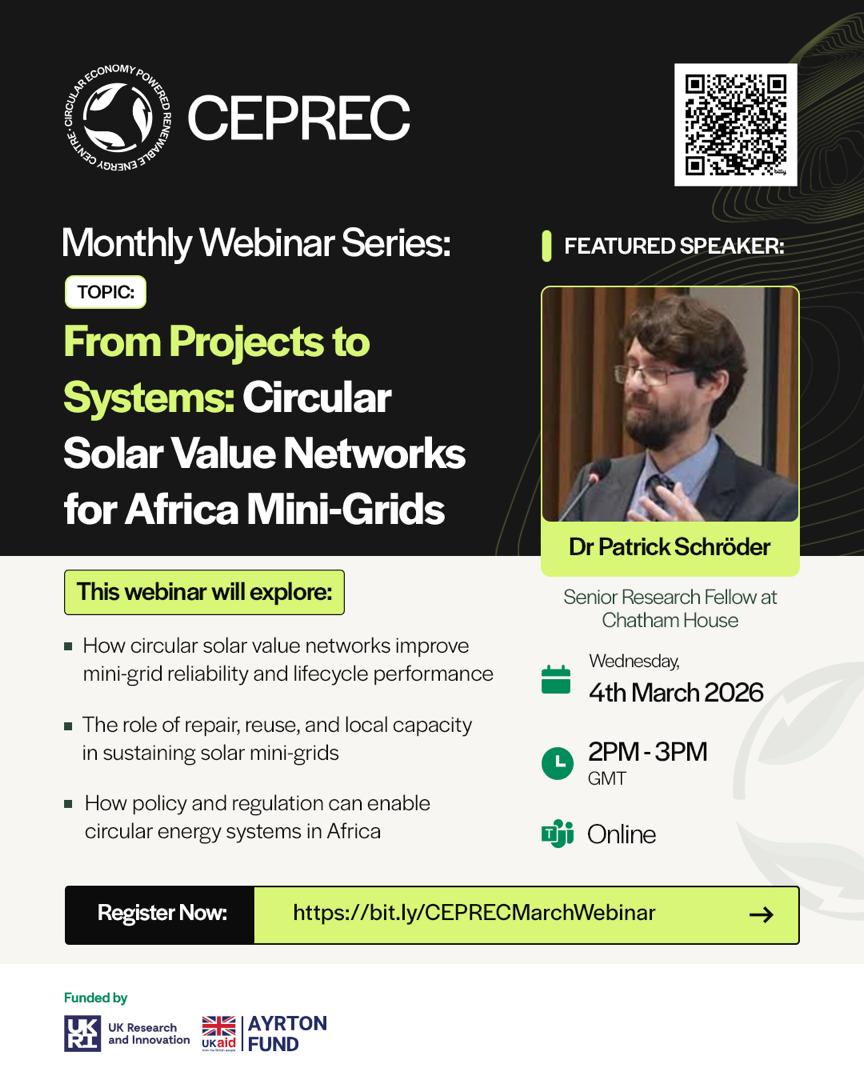
We’re pleased to share a new policy analysis authored by Elizabeth Adetoye, Afolashade Odumuyiwa and Patrick Schröder, published via Chatham House’s CircularEconomy.earth, as part of CEPREC’s ongoing policy engagement.

The article examines a critical but often overlooked issue in Africa’s energy transition: how the rapid expansion of solar mini-grids risks creating long-term sustainability challenges if repair, reuse, skills, and end-of-life considerations are not embedded from the outset.

Drawing on circular economy principles, the piece highlights why system design, local capacity building, and policy alignment are essential to ensure that off-grid energy infrastructure delivers lasting value, not future risk.

This work reflects CEPREC’s wider focus on aligning clean energy access with circularity, resilience, and locally grounded capability across Africa.

🔗 Read the full article here: https://circulareconomy.earth/publications/circularity-of-solar-mini-grids-in-africa

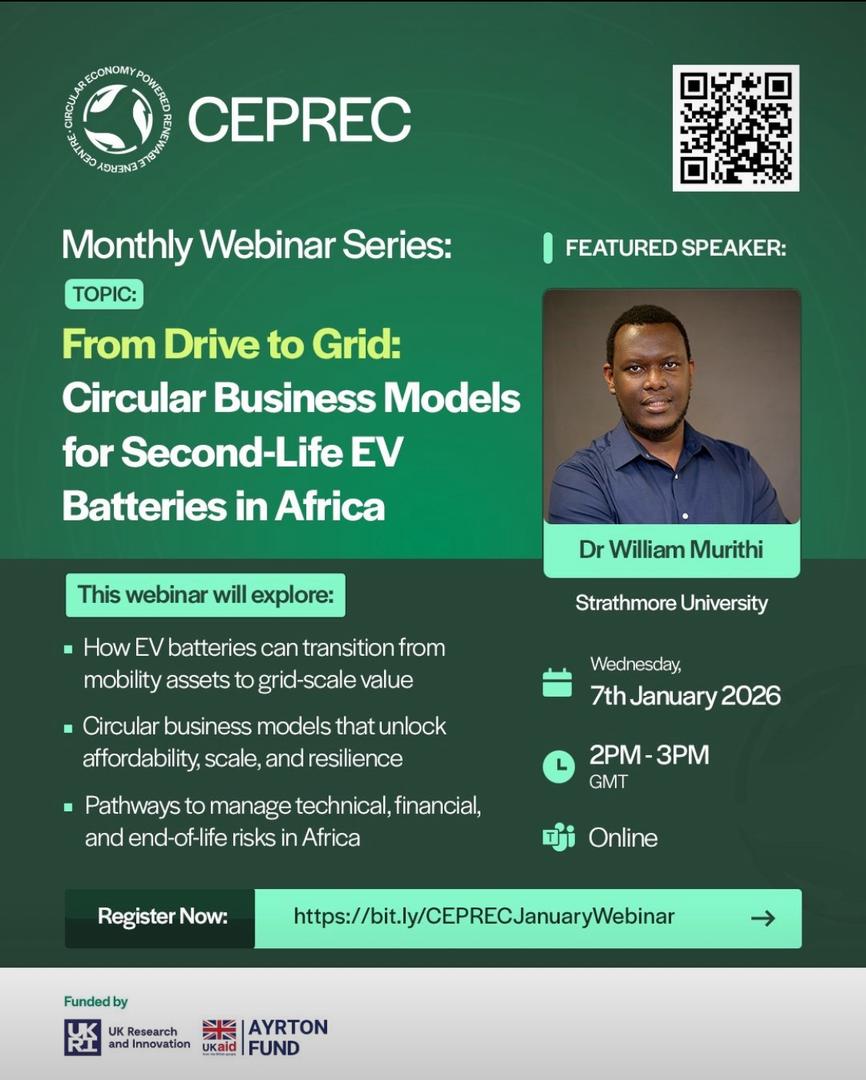
From Drive to Grid: Circular Business Models for Second-Life EV Batteries in Africa

As electric vehicle deployment accelerates alongside renewable energy expansion, Africa faces a critical opportunity to unlock the value of end-of-life EV batteries beyond mobility. This webinar examines how second-life EV batteries can be repurposed into stationary energy storage systems through circular business models tailored to African energy markets.

Focusing on models such as Battery-as-a-Service, Energy-as-a-Service, and product-service systems, the session explores how business innovation, rather than technology alone, can reduce upfront costs, manage risk, and enable scale across mini-grids, commercial, industrial, and community energy systems. Grounded in Africa-relevant use cases, the webinar highlights how circular business models can support energy access, affordability, and system resilience, while embedding repair, reuse, and responsible end-of-life management from the outset.

Designed for practitioners, policymakers, innovators, financiers, and development partners, the session offers practical insights into translating second-life battery potential into bankable, scalable energy solutions.

Register here: https://lnkd.in/eUKigyqJ

From Innovation to Inclusion: Advancing Circular Energy Access in Rural Africa

As Africa’s renewable energy transition accelerates with the rise of new technologies and the integration of circular economy principles, crucial questions emerge about how these innovations can be deployed responsibly and equitably.

This talk examines how circular energy solutions can be implemented in ways that are environmentally sound, socially inclusive, and grounded in local realities. It highlights the importance of understanding the entire value chain of circular energy systems, from sourcing and repurposing to deployment and end-of-life management, to ensure that rural energy initiatives are both impactful and sustainable.

The session will emphasise that circularity extends far beyond repurposing and recycling. It requires evidence-informed policies, inclusive decision-making, and context-appropriate planning to ensure that circular microgrids contribute meaningfully to equitable and resilient rural energy access across Africa

From Innovation to Impact: Advancing the Adoption of Circular Energy Solutions

Across Africa, a growing number of technologies are being developed to advance sustainable electrification through circular economy principles, from refurbishing and repurposing batteries to creating cleaner, more efficient energy systems. Yet, while these innovations hold immense potential, their real impact depends on adoption and use within communities.

This webinar takes an ecosystem perspective, examining how social, cultural, and economic factors shape the journey of innovation from labs to livelihoods. It will explore the interplay between supply and demand-side dynamics, from investment decisions and market readiness to user awareness and behavioural change, and the crucial role of policy, standards, and regulation in enabling scale.

By connecting the dots between technology development and social adoption, the session highlights how inclusive innovation ecosystems can accelerate Africa’s transition to a sustainable, equitable, and circular energy future.

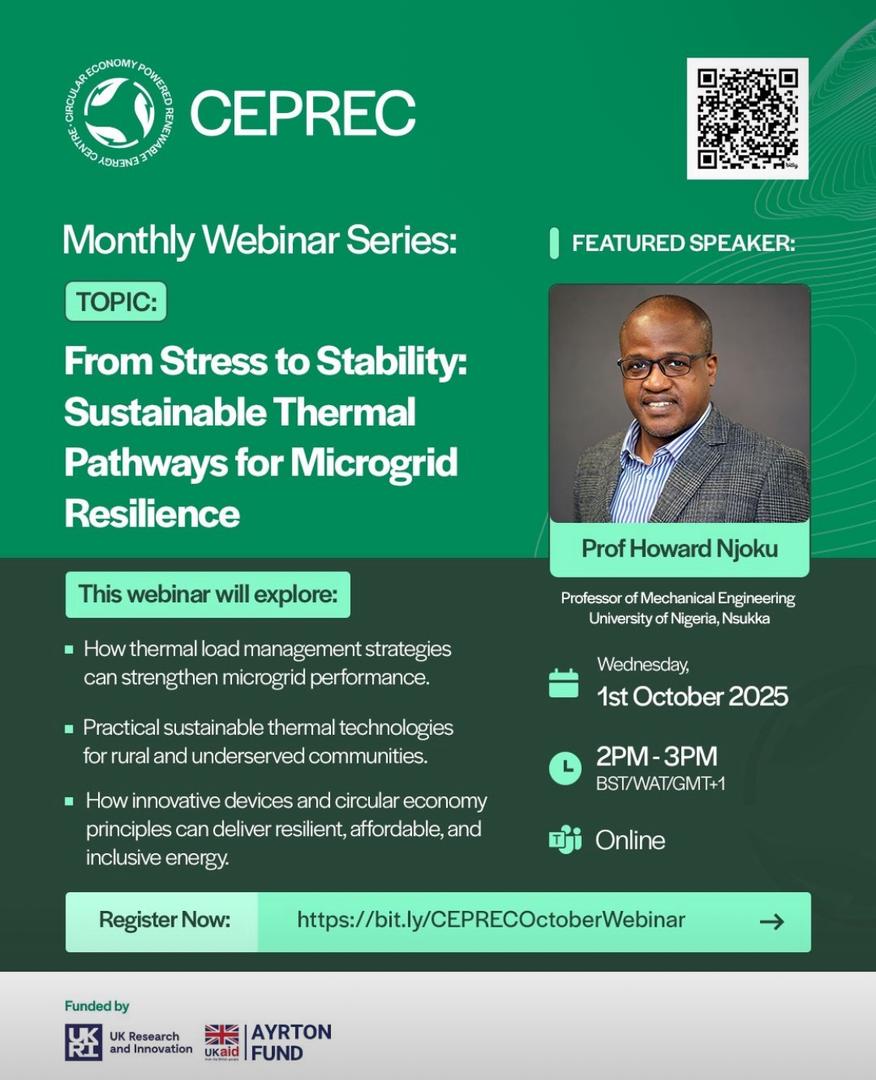
From Stress to Stability: Sustainable Thermal Pathways for Microgrid Resilience

Microgrids are vital to expanding clean energy access across Africa, yet their reliability is often challenged by mismatched demand peaks, high thermal loads, and limited storage capacity. This webinar will explore how sustainable thermal technologies can ease pressure on microgrids through strategies such as load shifting, peak shaving, demand avoidance, and hybridisation.

We will examine innovative solutions including thermal storage, solar water distillation, solar-driven cooling, and low-energy indoor comfort systems. Drawing on insights from the CEPREC Project, the session will highlight how novel thermal devices and circular economy principles can strengthen microgrid resilience while delivering sustainable, affordable solutions for rural and underserved communities.
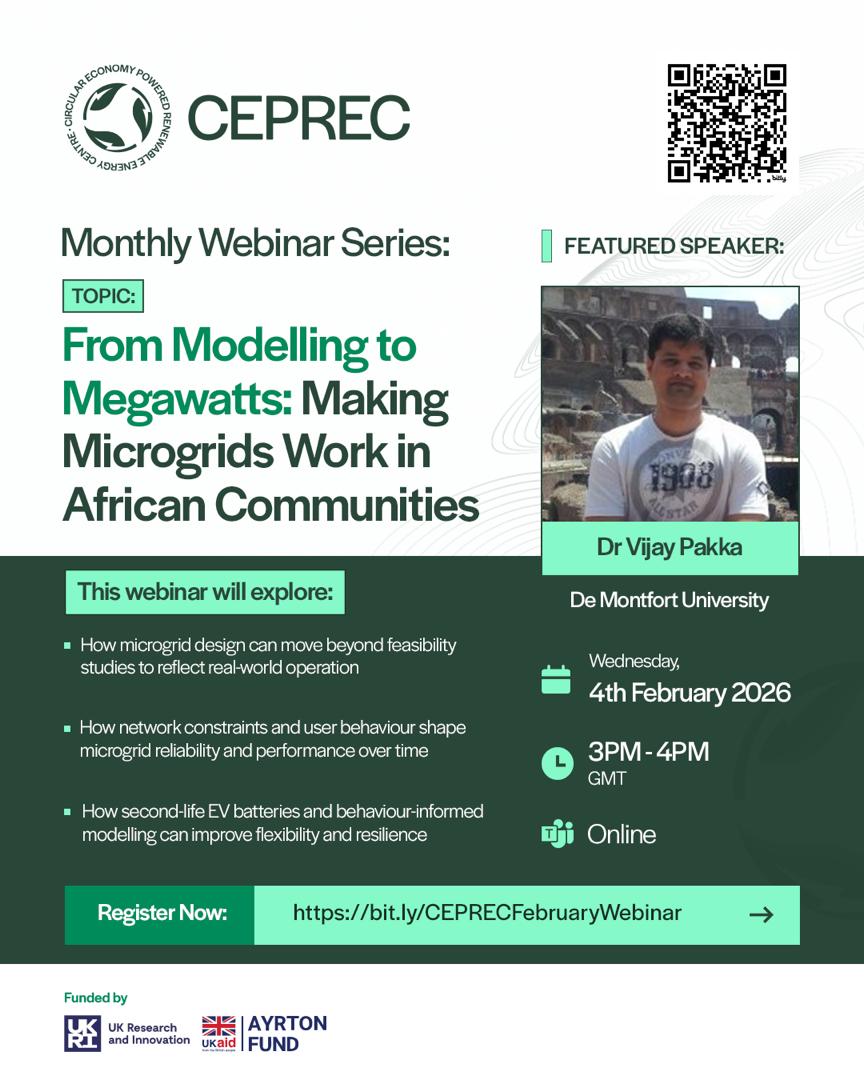
From Perception to Power: Understanding Consumer Behaviour in Africa’s Clean Energy Transition

Adopting renewable energy technologies is vital for Africa’s sustainable energy future. Yet human behaviour, shaped by behavioural, economic, and psychological factors, remains complex. Understanding and anticipating these behaviours is key to creating policies and business models that accelerate clean energy uptake.

Drawing on empirical data, this session will cover:

  • How consumers perceive renewable energy technologies
  • Behavioural models explaining adoption drivers and barriers
  • Practical strategies for influencing decision-making

Join us to discover how these insights can inform policy, guide business innovation, and strengthen community engagement for a just, inclusive energy transition.

From Waste to Watts: Unlocking Safe, Second-Life Energy Storage for Africa’s Mini-Grids

As electric vehicles (EVs) surge globally, the retirement of EV batteries is creating a new kind of challenge—how to safely manage this growing stream of battery e-waste.

In Africa, this challenge intersects with a pressing opportunity: the urgent need for affordable, reliable energy storage to support renewable-powered mini-grids in underserved communities.

This webinar, hosted by the CEPREC team at Kigali Collaborative Research Centre (KCRC), explores how second-life EV batteries—still holding substantial capacity—can be safely repurposed to meet this need. We’ll explore:

  • Safety protocols and standards for battery reuse
  • Circular business models that enable scale and impact
  • Real-world case studies from across the continent
  • Financing implications and risk management

Join us to learn how the circular economy is transforming waste into opportunity—safely powering Africa’s energy future.

From Wheels to Watts: Powering Africa with Retired EV Motors

As Africa scales up electrification efforts, the demand for clean, cost-effective energy solutions is greater than ever. But what if the key lies in components we already have?

Join us for an insightful webinar with Dr. Udochukwu Bola Akuru (Tshwane University of Technology), as we explore how end-of-life electric vehicle (EV) motors—especially permanent magnet synchronous machines (PMSMs)—can be repurposed to generate electricity for decentralised microgrids across Africa.

We’ll cover:

  • The engineering behind reconfiguring EV motors for small-scale power generation
  • Challenges like thermal performance, rare earth magnet degradation, and rotor compatibility
  • Opportunities to align e-waste management, local manufacturing, and renewable integration
  • The potential for circular economy innovation that reduces cost, builds resilience, and empowers African communities

This session will connect practical engineering with the vision for a sustainable, circular energy transition.

From Road to Grid: Exploring the Second Life Potential of EV Power Electronics

Join us for the kickoff of CEPREC’s Monthly Webinar Series, featuring Professor Layi Alatise, Royal Society Industry Fellow in Power Electronics at the University of Warwick.

This session explores the untapped potential of power electronic components from electric vehicles (EVs) and how they can be repurposed for use in renewable energy systems across Africa. Learn how retired converters and inverters could power homes, clinics, and microgrids—supporting Africa’s clean energy future through circular innovation.

Whether you're a researcher, policymaker, engineer, or just curious about sustainable tech—this webinar is for you.

CEPREC team members Dr Patrick Schröder and Professor Muyiwa Oyinlola contributed to the Winter edition of The World Today (Chatham House’s international affairs magazine) with a field-based reflection on how solar mini-grids are reshaping rural electrification in Nigeria.

Drawing on direct engagement with Nigeria’s Rural Electrification Agency of Nigeria and on-the-ground project experience with CEESOLAR, the article examines how decentralised energy systems, policy coordination, and international partnerships are expanding access to power. It also raises critical questions around energy sovereignty, local manufacturing, and the role of circularity in Africa’s clean energy transition.

The piece highlights why repair, reuse, and second-life technologies must be embedded from the outset if renewable energy systems are to deliver long-term resilience and local value; a core focus of CEPREC’s work across the continent.

Read the full article here 👇🏾

https://www.chathamhouse.org/publications/the-world-today/2025-12/nigeria-sparking-renewable-solutions-its-energy-crisis?utm_source=linkedin.com&utm_medium=organic-social&utm_campaign=twt-dec25-postcard-nigeria&utm_content=twt-dec25-postcard-nigeria-content

CEPREC was honoured to co-host the Green Digital Infrastructure for Africa Dialogue on the sidelines of #UNGA80 in New York, convened by the Federal Ministry of Communications, Innovation & Digital Economy (FMCIDE) in partnership with the African Telecommunications Union (ATU).

Our Director, Professor Muyiwa Oyinlola, chaired the opening panel on Africa’s Green Infrastructure, where panellists Vanessa Gray (International Telecommunication Union) and Soji Maurice-Diya (NATCOM) highlighted opportunities to green Africa’s digital backbone and reduce reliance on diesel generators.

Our Deputy Director, Professor Giuliana Battisti, joined IHS Towers COO, Kazeem Oladepo, on the panel Mobilising Partnerships & Finance, moderated by Osibo I..

Drawing on CEPREC’s field-based research, she emphasised the importance of local capacity, skills development, and innovation as key enablers for unlocking sustainable investment in Africa’s digital and energy transitions. With connectivity expanding rapidly, the dialogue reinforced that Africa’s digital and energy transitions must go hand in hand, ensuring growth that is reliable, affordable, and environmentally friendly.

A huge thank you to FMCIDE for convening such an important conversation. CEPREC remains committed to advancing research, innovation, and partnerships that drive Africa’s green digital future.

As COP30 Brazil enters its second week, the CEPREC team continues to engage actively through discussions, presentations, and roundtables, contributing to global conversations on Africa’s just, inclusive, and circular energy transition.

Our engagements have focused on advancing capacity building, innovation, and indigenous knowledge systems all vital to accelerating sustainable electrification and ensuring no one is left behind.CEPREC’s work aligns with COP30’s key objectives:

  • Tripling renewables and expanding universal energy access
  • Fostering education, capacity building, and job creation for climate action
  • Promoting innovation, circularity, and sustainable systems for long-term resilience.

By collaborating across government, industry, and academia, we are helping to shape an energy future that is clean, equitable, and locally driven.

CEPREC team members Dr Abi Okoya and Professor Muyiwa Oyinlola facilitated a workshop on Circular Economy for Energy and Sustainability at the Global Sustainability and Education Leadership (G-SEL Conference) Conference 2025.

It was inspiring to see such enthusiasm and thoughtful engagement from participants, exploring how circular thinking can drive a more inclusive and sustainable energy future.

A big thank you to the organisers and everyone who joined the discussion. Events like this highlight the power of collaboration, innovation, and shared learning in driving real change.

The Human Side of the Energy Transition

The shift to clean energy in Africa is not only a technical or financial challenge. It is, at its core, a human one. Across the continent, governments, innovators and communities are working to expand access to electricity through renewable solutions such as solar microgrids, wind power and repurposed electric-vehicle technologies. Yet technology alone cannot deliver transformation.

To achieve universal, sustainable energy access, we must first understand how people think, decide and act.

“Clean energy adoption is not just about affordability. It is about perception, trust and the way people make decisions.”

The Three Traps That Hold Us Back

In behavioural economics, many policies fail not because they are poorly designed, but because they fall into what Banerjee and Duflo, winners of the Nobel Memorial Prize in Economic Sciences in 2019 call the three I’s trap: Ideology, Ignorance and Inertia.

  • Ideology blinds experts who assume technical superiority will automatically translate into adoption.
  • Ignorance limits funders or aid organisations who overlook local contexts.
  • Inertia slows policymakers who postpone decisions or rely on outdated systems.

Recognising these traps allows us to design smarter, more responsive interventions that align with real human behaviour rather than idealised assumptions.

Income Isn’t Everything

A common simplification is that energy choices depend purely on income. If people can afford solar panels or electric cookers, they will buy them. Reality is far more nuanced.

Human decision-making is shaped by attitudes, risk perception, social influence and trust. In many African contexts, even when people can afford a renewable option, uncertainty about performance, maintenance or social acceptance can prevent adoption.

In one study we conducted in Lagos, rural consumers prioritised community ownership of mini-grids, while urban consumers valued uninterrupted power and flexible payments. The same technology meant different things to different people.

“Consumers are not just buyers of electricity; they are active participants in shaping the energy future.”

Circular Microgrids and Behavioural Insight

At the Circular Economy Powered Renewable Energy Centre (CEPREC), we are developing circular microgrids that repurpose end-of-life electric-vehicle components which includes; batteries, converters and motors to provide low-cost, reliable electricity.

But engineering excellence must meet behavioural understanding. The success of these systems depends on whether households and communities trust the technology, perceive value, and feel ownership of the solution.

That is why we combine social-science methods such as surveys, focus groups and choice-modelling, with engineering innovation. By mapping preferences, awareness and risk perception, we can design energy systems that people truly want and use.

Nudging Towards Sustainable Choices

Policy and market incentives alone are not enough. Behavioural insights show that information and framing can dramatically influence energy behaviour.

  • Feedback and comparisons: Showing households how their energy use compares to similar homes encourages efficiency.
  • Positive reinforcement: Simple visual feedback, such as an app notification celebrating energy-saving behaviour—builds long-term habits.
  • Targeted messaging: Tailored communication that addresses trust, reliability and cost transparency helps overcome scepticism about renewables.

These “nudges” are low-cost but powerful tools to promote sustainable choices without restricting freedom.

Towards Behaviour-Smart Energy Policy

Africa’s energy transition cannot rely solely on imported models or assumptions. We must design policies that reflect local perceptions, cultural values and decision patterns.

That means:

  • Integrating behavioural data into national energy planning.
  • Supporting local institutions to design community-centred energy programmes.
  • Building public trust through transparency and participation.

When people understand and believe in the change, adoption follows naturally.

The Power of Perception

From Nigeria to Rwanda, Kenya to Namibia, one message is clear: technology may generate power, but people generate progress.

If we can turn perception into power by understanding how consumers think and behave, we can accelerate Africa’s clean energy journey, ensuring it is not only renewable, but truly inclusive.

The Circular Economy Powered Renewable Energy Centre (CEPREC) has officially launched, marking a ground-breaking step towards addressing Africa’s energy and e-waste challenges.

Operating as a Pan-African, multisectoral, and interdisciplinary Research Centre, CEPREC unites academia, government, and industry to drive collaborative research, innovation, and capacity building. The Centre is committed to developing cutting-edge knowledge and skills that leverage circular economy principles to support Africa’s energy transition

CEPREC is funded by the UK Government’s Ayrton Fund, a £1 billion commitment to clean energy research and development. The initiative is supported by an extensive partnership involving over 30 stakeholders from government, industry, and academia across the United Kingdom and sub-Saharan Africa. Initially, CEPREC will operate in six sub-Saharan African countries Nigeria, South Africa, Kenya, Sierra Leone, Namibia, and Rwanda before expanding further across the continent.

Frances Wood, UKRI International Director, said: “The Ayrton Challenge Programme demonstrates the power of research and innovation to address critical global challenges. These projects exemplify how equitable, interdisciplinary collaboration can unlock transformative solutions, ensuring a sustainable and inclusive energy future for all.” CEPREC will empower local researchers, policymakers, and entrepreneurs to develop, manage, and scale circular microgrid projects through workshops, training programmes, and interdisciplinary knowledge-sharing.

Professor Muyiwa Oyinlola, Director of CEPREC and Professor of Innovation for Sustainable Development at De Montfort University, said: "CEPREC was set up to transform the way we think about waste, —turning it into opportunity, empowering communities, and driving economic transformation. This initiative will set a new benchmark for sustainable energy solutions across Africa.

Professor Layi Alatise, Deputy Director (Engineering) of CEPREC, and Professor in Power Electronics at University of Warwick, said: "When technology is implemented without local capacity to maintain and expand it, sustainability is compromised.

CEPREC will prioritise knowledge transfer and skills development to ensure its impact is long-lasting. By integrating circular economy principles into Africa’s energy sector, we are creating a resilient and sustainable future."

Professor Giuliana Battisti, Deputy Director (Social Sciences) of CEPREC and Professor of the Economics of Innovation at Warwick Business School, added: "This initiative represents a unique opportunity to align cutting-edge research with real-world applications. By combining technological innovation with policy integration, we can create a self-sustaining ecosystem for Africa’s renewable energy future.” Chatham House, the globally renowned think tank, is also a collaborator, to ensure that research is transformed into actionable policies, shaping national, regional, and international energy strategies while guiding key decision-makers in sustainable energy and circular economy practices. Dr. Patrick Schroeder, Senior Research

Fellow at Chatham House, who is leading CEPREC’s Policy engagement, also said: "The transition to a circular economy is not just an environmental imperative; it requires a comprehensive international policy framework that fosters innovation, collaboration, and sustainable practices across all sectors."

CEPREC’s initial focus countries were strategically selected to represent the diversity of sub-Saharan Africa, covering East, West, and Southern regions. These countries differ significantly in energy access rates, economic scale, and population size, — from 85% energy access in South Africa to just 5% in rural Sierra Leone, and from Nigeria’s $477 billion GDP to Sierra Leone’s $4 billion economy. This diversity ensures that CEPREC addresses a broad spectrum of challenges and opportunities across the continent.

The long-term vision for CEPREC is to establish itself as the leading research centre driving new knowledge, policy development, and skills empowerment for Africa’s energy transition. The initiative aligns with key UN Sustainable Development Goals (SDGs), particularly:

  • SDG 7: Affordable and Clean Energy
  • SDG 12: Responsible Consumption and Production
  • SDG 13: Climate Action

With the official launch of CEPREC, key stakeholders are invited to collaborate on this transformative initiative. In her remarks, Abi Okoya, Head of Strategic Partnerships said, “CEPREC is committed to forging transformative partnerships that drive Africa’s sustainable energy future. This is more than a Centre—it’s a movement to unite government, industry, and academia in creating innovative, circular solutions that will redefine how we power our communities. We invite stakeholders from across the continent and beyond to join us in scaling impact, driving policy change, and ensuring that Africa leads the global transition to sustainable and inclusive energy systems.”

Subscribe to newsletter

Subscribe to receive the latest blog posts to your inbox every week.

By subscribing you agree to with our Privacy Policy.
Thank you! Your submission has been received!
Oops! Something went wrong while submitting the form.

Join us in empowering Africa’s sustainable energy future.

Our mission is to provide sustainable energy solutions tailored to local needs that are accessible and affordable.