Press release

£3.5M Pan-African Research Centre Launches to Drive Renewable Energy Innovation Through Circular Economy Principles

Prof. Muyiwa Oyinlola
September 6, 2025

The Human Side of the Energy Transition

The shift to clean energy in Africa is not only a technical or financial challenge. It is, at its core, a human one. Across the continent, governments, innovators and communities are working to expand access to electricity through renewable solutions such as solar microgrids, wind power and repurposed electric-vehicle technologies. Yet technology alone cannot deliver transformation.

To achieve universal, sustainable energy access, we must first understand how people think, decide and act.

“Clean energy adoption is not just about affordability. It is about perception, trust and the way people make decisions.”

The Three Traps That Hold Us Back

In behavioural economics, many policies fail not because they are poorly designed, but because they fall into what Banerjee and Duflo, winners of the Nobel Memorial Prize in Economic Sciences in 2019 call the three I’s trap: Ideology, Ignorance and Inertia.

  • Ideology blinds experts who assume technical superiority will automatically translate into adoption.
  • Ignorance limits funders or aid organisations who overlook local contexts.
  • Inertia slows policymakers who postpone decisions or rely on outdated systems.

Recognising these traps allows us to design smarter, more responsive interventions that align with real human behaviour rather than idealised assumptions.

Income Isn’t Everything

A common simplification is that energy choices depend purely on income. If people can afford solar panels or electric cookers, they will buy them. Reality is far more nuanced.

Human decision-making is shaped by attitudes, risk perception, social influence and trust. In many African contexts, even when people can afford a renewable option, uncertainty about performance, maintenance or social acceptance can prevent adoption.

In one study we conducted in Lagos, rural consumers prioritised community ownership of mini-grids, while urban consumers valued uninterrupted power and flexible payments. The same technology meant different things to different people.

“Consumers are not just buyers of electricity; they are active participants in shaping the energy future.”

Circular Microgrids and Behavioural Insight

At the Circular Economy Powered Renewable Energy Centre (CEPREC), we are developing circular microgrids that repurpose end-of-life electric-vehicle components which includes; batteries, converters and motors to provide low-cost, reliable electricity.

But engineering excellence must meet behavioural understanding. The success of these systems depends on whether households and communities trust the technology, perceive value, and feel ownership of the solution.

That is why we combine social-science methods such as surveys, focus groups and choice-modelling, with engineering innovation. By mapping preferences, awareness and risk perception, we can design energy systems that people truly want and use.

Nudging Towards Sustainable Choices

Policy and market incentives alone are not enough. Behavioural insights show that information and framing can dramatically influence energy behaviour.

  • Feedback and comparisons: Showing households how their energy use compares to similar homes encourages efficiency.
  • Positive reinforcement: Simple visual feedback, such as an app notification celebrating energy-saving behaviour—builds long-term habits.
  • Targeted messaging: Tailored communication that addresses trust, reliability and cost transparency helps overcome scepticism about renewables.

These “nudges” are low-cost but powerful tools to promote sustainable choices without restricting freedom.

Towards Behaviour-Smart Energy Policy

Africa’s energy transition cannot rely solely on imported models or assumptions. We must design policies that reflect local perceptions, cultural values and decision patterns.

That means:

  • Integrating behavioural data into national energy planning.
  • Supporting local institutions to design community-centred energy programmes.
  • Building public trust through transparency and participation.

When people understand and believe in the change, adoption follows naturally.

The Power of Perception

From Nigeria to Rwanda, Kenya to Namibia, one message is clear: technology may generate power, but people generate progress.

If we can turn perception into power by understanding how consumers think and behave, we can accelerate Africa’s clean energy journey, ensuring it is not only renewable, but truly inclusive.

The Circular Economy Powered Renewable Energy Centre (CEPREC) has officially launched, marking a ground-breaking step towards addressing Africa’s energy and e-waste challenges.

Operating as a Pan-African, multisectoral, and interdisciplinary Research Centre, CEPREC unites academia, government, and industry to drive collaborative research, innovation, and capacity building. The Centre is committed to developing cutting-edge knowledge and skills that leverage circular economy principles to support Africa’s energy transition

CEPREC is funded by the UK Government’s Ayrton Fund, a £1 billion commitment to clean energy research and development. The initiative is supported by an extensive partnership involving over 30 stakeholders from government, industry, and academia across the United Kingdom and sub-Saharan Africa. Initially, CEPREC will operate in six sub-Saharan African countries Nigeria, South Africa, Kenya, Sierra Leone, Namibia, and Rwanda before expanding further across the continent.
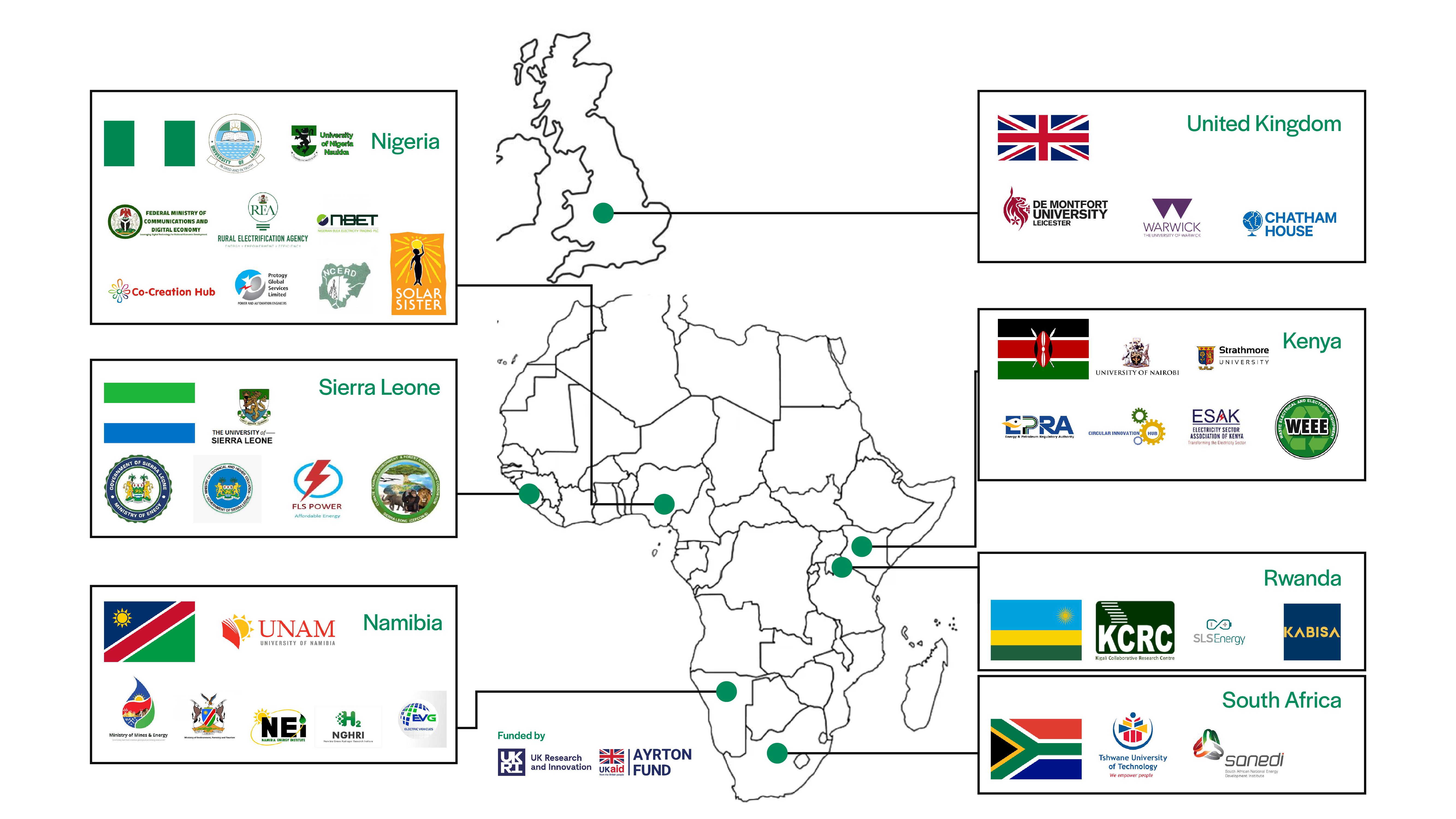
Frances Wood, UKRI International Director, said: “The Ayrton Challenge Programme demonstrates the power of research and innovation to address critical global challenges. These projects exemplify how equitable, interdisciplinary collaboration can unlock transformative solutions, ensuring a sustainable and inclusive energy future for all.” CEPREC will empower local researchers, policymakers, and entrepreneurs to develop, manage, and scale circular microgrid projects through workshops, training programmes, and interdisciplinary knowledge-sharing.

Professor Muyiwa Oyinlola, Director of CEPREC and Professor of Innovation for Sustainable Development at De Montfort University, said: "CEPREC was set up to transform the way we think about waste, —turning it into opportunity, empowering communities, and driving economic transformation. This initiative will set a new benchmark for sustainable energy solutions across Africa.

Professor Layi Alatise, Deputy Director (Engineering) of CEPREC, and Professor in Power Electronics at University of Warwick, said: "When technology is implemented without local capacity to maintain and expand it, sustainability is compromised.

CEPREC will prioritise knowledge transfer and skills development to ensure its impact is long-lasting. By integrating circular economy principles into Africa’s energy sector, we are creating a resilient and sustainable future."

Professor Giuliana Battisti, Deputy Director (Social Sciences) of CEPREC and Professor of the Economics of Innovation at Warwick Business School, added: "This initiative represents a unique opportunity to align cutting-edge research with real-world applications. By combining technological innovation with policy integration, we can create a self-sustaining ecosystem for Africa’s renewable energy future.” Chatham House, the globally renowned think tank, is also a collaborator, to ensure that research is transformed into actionable policies, shaping national, regional, and international energy strategies while guiding key decision-makers in sustainable energy and circular economy practices. Dr. Patrick Schroeder, Senior Research

Fellow at Chatham House, who is leading CEPREC’s Policy engagement, also said: "The transition to a circular economy is not just an environmental imperative; it requires a comprehensive international policy framework that fosters innovation, collaboration, and sustainable practices across all sectors."

CEPREC’s initial focus countries were strategically selected to represent the diversity of sub-Saharan Africa, covering East, West, and Southern regions. These countries differ significantly in energy access rates, economic scale, and population size, — from 85% energy access in South Africa to just 5% in rural Sierra Leone, and from Nigeria’s $477 billion GDP to Sierra Leone’s $4 billion economy. This diversity ensures that CEPREC addresses a broad spectrum of challenges and opportunities across the continent.

The long-term vision for CEPREC is to establish itself as the leading research centre driving new knowledge, policy development, and skills empowerment for Africa’s energy transition. The initiative aligns with key UN Sustainable Development Goals (SDGs), particularly:

  • SDG 7: Affordable and Clean Energy
  • SDG 12: Responsible Consumption and Production
  • SDG 13: Climate Action

With the official launch of CEPREC, key stakeholders are invited to collaborate on this transformative initiative. In her remarks, Abi Okoya, Head of Strategic Partnerships said, “CEPREC is committed to forging transformative partnerships that drive Africa’s sustainable energy future. This is more than a Centre—it’s a movement to unite government, industry, and academia in creating innovative, circular solutions that will redefine how we power our communities. We invite stakeholders from across the continent and beyond to join us in scaling impact, driving policy change, and ensuring that Africa leads the global transition to sustainable and inclusive energy systems.”

Subscribe to newsletter

Subscribe to receive the latest blog posts to your inbox every week.

By subscribing you agree to with our Privacy Policy.
Thank you! Your submission has been received!
Oops! Something went wrong while submitting the form.

Join us in empowering Africa’s sustainable energy future.

Our mission is to provide sustainable energy solutions tailored to local needs that are accessible and affordable.